
Description
Seed Phrase Phishing Recovery for Stolen Cryptocurrency
A seed phrase is one of the most sensitive pieces of information associated with a cryptocurrency wallet. When scammers convince a wallet owner to disclose a recovery phrase, they may gain the ability to control the assets associated with that wallet.
Seed phrase phishing commonly happens through fake wallet popups, fake support representatives, malicious websites, fake airdrops, fraudulent wallet updates, search-engine advertisements, social-media messages, and impersonation scams.
When cryptocurrency has already been transferred from a compromised wallet, seed phrase phishing recovery begins with determining what happened to the assets after the unauthorized transactions occurred.
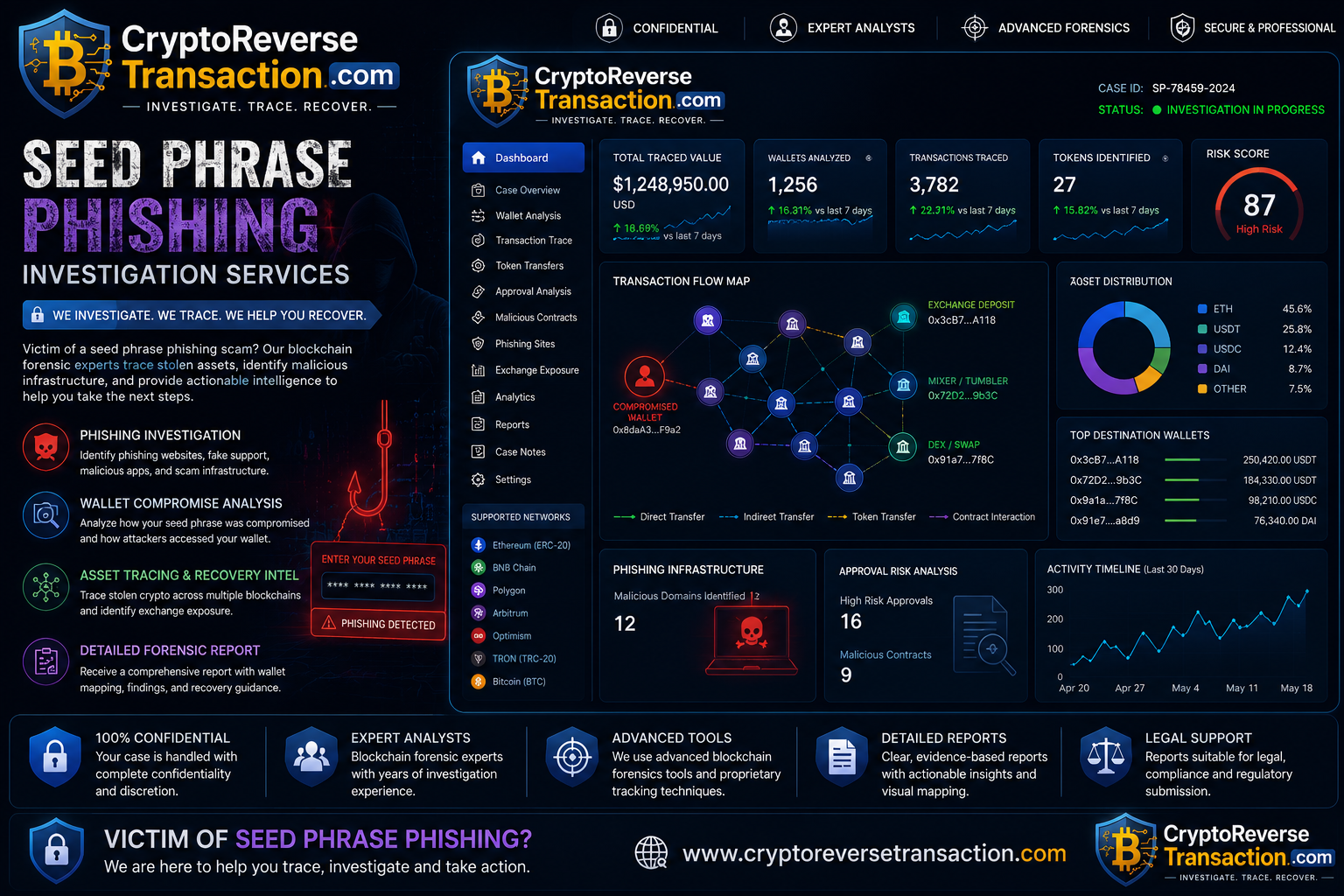
Our seed phrase phishing recovery service focuses on blockchain tracing and forensic analysis. The investigation can examine transaction hashes, destination wallets, token movements, exchange deposits, cross-chain transfers, and other available evidence.
The objective is not to promise that every stolen asset can be recovered. Instead, seed phrase phishing recovery involves establishing the transaction history and determining whether there are identifiable pathways that may support further recovery action.
The source material for this service states that the initial case evaluation costs $99, with contingency-based recovery work described as having no upfront recovery-work fee.
If you believe your wallet has been compromised, time can be important. Before beginning any seed phrase phishing recovery investigation, secure any assets that remain in the compromised wallet and avoid giving the old wallet additional funds.
What Is Seed Phrase Phishing?
Seed phrase phishing is a form of cryptocurrency fraud in which a scammer tricks a wallet owner into revealing their recovery phrase.
The source material describes a seed phrase as the master credential for a wallet and warns that anyone who obtains it may be able to access the associated wallet.
Unlike a conventional website password, a wallet recovery phrase cannot simply be reset through an email-password recovery process.
That makes seed phrase phishing recovery fundamentally different from recovering a forgotten website password.
If a scammer obtains the phrase, they may be able to import the wallet into another wallet application and transfer assets to addresses they control.
Once those transactions occur, seed phrase phishing recovery may require blockchain forensic analysis to determine where the assets went.
Common Seed Phrase Phishing Scams
Scammers constantly change the appearance and delivery method of their phishing campaigns, but several patterns appear repeatedly.
1. Fake Wallet Popups
A fake popup may appear while someone is using a cryptocurrency website.
The popup can imitate the appearance of MetaMask, Trust Wallet, Phantom, Ledger, or another familiar wallet.
The victim may see a message such as a supposed connection failure or security problem and be instructed to enter a recovery phrase.
The source specifically identifies fake MetaMask, Trust Wallet, and Phantom-style wallet popups as examples of seed phrase phishing.
A legitimate wallet connection request should never require you to disclose your recovery phrase to a website.
If you already entered your phrase, seed phrase phishing recovery should begin with securing any remaining assets and documenting the unauthorized transactions.
Fake Hardware Wallet Alerts
Another common technique is impersonating a hardware-wallet manufacturer.
A scammer may send an email or notification claiming that a Ledger device has experienced a security breach or requires an urgent verification.
The victim is then redirected to a fake website.
The fraudulent website may look convincing and request the wallet’s recovery phrase.
The source specifically identifies fake Ledger security alerts as one form of seed phrase phishing.
Never provide a recovery phrase because an email, popup, social-media account, or support representative tells you that your wallet is at risk.
Fake Support Impersonation
Fake support is another major seed phrase phishing technique.
A scammer may approach a victim through Discord, Telegram, X/Twitter, email, or another communication channel while pretending to work for a wallet provider, exchange, NFT project, or cryptocurrency platform.
The scammer may claim that:
- Your wallet has been flagged.
- Your account is under investigation.
- Your wallet has been compromised.
- Your transaction is stuck.
- Your wallet requires verification.
- Your account needs to be restored.
- Your funds will be lost unless you act immediately.
The victim is then instructed to provide the seed phrase.
The source specifically identifies fake support impersonation through Discord, Telegram, and Twitter as a common scenario.
If a supposed support agent asks for your seed phrase, stop communicating with them.
If cryptocurrency has already been stolen, seed phrase phishing recovery should focus on the blockchain transactions rather than providing the scammer—or another supposed recovery agent—with additional credentials.
Fake Airdrop Seed Phrase Scams
Fake airdrops can be used to persuade users to visit malicious websites.
A scammer may claim that the victim is eligible for free cryptocurrency and instruct them to connect a wallet or enter a recovery phrase.
The source specifically identifies fake airdrop claims as a seed phrase phishing method.
A legitimate promotional campaign should not require you to disclose your wallet’s recovery phrase.
If you have already interacted with a suspicious airdrop website, document the website, transaction history, contract address, and wallet activity.
This information can be useful during seed phrase phishing recovery.
Fake Wallet Updates
Another technique involves a fraudulent wallet update.
A victim may see a message claiming that Trust Wallet or another wallet application requires a critical update.
The fake update page then requests the recovery phrase.
The source identifies this as another seed phrase phishing scenario.
Only obtain wallet software from the wallet provider’s legitimate channels.
If you have already entered your phrase on a fake update page, treat the wallet as compromised and take immediate security measures.
Search Engine Phishing
Search engines can also be used to direct users toward fraudulent cryptocurrency websites.
Someone may search for:
- MetaMask login
- Ledger Live download
- Trust Wallet support
- Wallet recovery
- Crypto exchange support
A fraudulent advertisement or website may appear among the results.
The victim visits the website believing it is legitimate and is then asked for their recovery phrase.
The source specifically includes paid search advertisements as one potential route for seed phrase phishing.
Always verify the domain carefully before entering cryptocurrency credentials.
Fake Cryptocurrency Giveaways
Giveaway scams can combine celebrity impersonation, fake websites, social-media posts, and fraudulent wallet instructions.
The victim may be promised a cryptocurrency reward and instructed to send funds or provide sensitive wallet information.
The source identifies fake Bitcoin giveaways as another example.
If cryptocurrency was transferred during such an incident, seed phrase phishing recovery may overlap with giveaway-scam tracing and stolen-crypto investigations.
Can Seed Phrase Phishing Recovery Recover Stolen Crypto?
Potentially, but seed phrase phishing recovery is not guaranteed.
Once cryptocurrency has been transferred from a compromised wallet, the transaction generally cannot simply be reversed by the victim.
The most important question becomes:
Where did the stolen cryptocurrency go?
A blockchain investigation can potentially identify:
- The first receiving address
- Subsequent wallets
- Token swaps
- Stablecoin conversions
- Cross-chain transfers
- Exchange deposits
- Bridge transactions
- Related addresses
- Transaction timing
- Other observable blockchain activity
The source states that speed and whether funds reach an exchange can affect a case.
However, tracing a wallet does not automatically identify a person or guarantee the return of funds.
That distinction is essential to responsible seed phrase phishing recovery.
Seed Phrase Phishing Recovery: Immediate Actions
If you have entered your seed phrase into a suspicious website, do not wait before securing any remaining assets.
The source specifically advises victims not to deposit additional funds into a compromised wallet and to move remaining funds to a new wallet.
Step 1: Stop Using the Compromised Wallet
If the recovery phrase has been exposed, assume the wallet may no longer be secure.
Step 2: Move Remaining Assets
If there are still assets in the compromised wallet and you can safely transfer them, move them to a completely new wallet with a new recovery phrase.
Step 3: Do Not Reuse the Exposed Seed Phrase
Creating a new password for the old wallet does not solve the fundamental problem if the recovery phrase has been exposed.
Step 4: Preserve Evidence
Save:
- Wallet addresses
- Transaction hashes
- Token contracts
- Approximate attack time
- Fake website address
- Screenshots
- Emails
- Discord messages
- Telegram messages
- X/Twitter usernames
- Fake support information
Step 5: Do Not Share Your Seed Phrase
This is critical.
A seed phrase should never be provided to a recovery company, investigator, exchange employee, support agent, or anyone else claiming to help.
The source itself explicitly states that the service does not require the victim’s seed phrase.
Our Seed Phrase Phishing Recovery Process
Step 1: Immediate Security Guidance
The source describes an immediate-action stage intended to help victims secure remaining funds and prevent additional losses.
The priority should always be protecting assets that have not yet been stolen.
Step 2: Initial Case Assessment
The next stage is to understand what happened.
Useful information includes:
- Fake website
- Fake support username
- Compromised wallet address
- Transaction hash
- Approximate attack time
- Type of cryptocurrency stolen
- Blockchain involved
The source identifies these types of information as relevant to the initial assessment.
You can begin through the Case Evaluation page.
Step 3: $99 Seed Phrase Phishing Recovery Evaluation
The source describes a $99 case evaluation in which a forensic analyst traces the stolen assets on the blockchain and attempts to determine where the scammer moved them.
A blockchain investigation can examine the movement of:
- Bitcoin
- Ethereum
- USDT
- USDC
- BNB
- Solana-based assets
- ERC-20 tokens
- Other supported digital assets
The actual investigative pathway depends on the blockchain and the transactions involved.
The source states that a detailed report is expected within approximately 3–7 business days, depending on the case.
Step 4: Recovery Strategy
If the investigation identifies meaningful transaction pathways, a recovery strategy may be considered.
The source describes a contingency model involving 20% of recovered funds, with no upfront recovery-work fee if the case proceeds under that arrangement.
Any potential recovery remains dependent on the circumstances of the case.
A successful blockchain trace does not itself guarantee that assets can be returned.
Step 5: Exchange Cooperation and Legal Channels
If stolen assets reach a centralized exchange, the exchange may become relevant to the investigation.
Potential evidence can include:
- Exchange deposit addresses
- Transaction hashes
- Timing
- Wallet relationships
- Asset type
- Destination addresses
However, an exchange deposit address does not automatically reveal the identity of an account holder.
Account information may require appropriate legal or compliance procedures.
The source describes exchange cooperation and law-enforcement involvement as part of its recovery process.
Seed Phrase Phishing Recovery and Exchange Deposits
A particularly important development in some cases occurs when stolen assets reach a centralized exchange.
Examples of major exchanges include:
These are provided as official exchange resources.
Finding a destination address associated with an exchange does not mean that the exchange caused the theft or that the account can automatically be frozen.
In seed phrase phishing recovery, exchange exposure is a lead that may require further evidence and appropriate procedures.
Seed Phrase Phishing Recovery and Blockchain Forensics
Blockchain forensic investigation is central to seed phrase phishing recovery.
An investigation can reconstruct the movement of assets from the compromised wallet.
For example:
Compromised wallet → scammer wallet → secondary wallet → token swap → stablecoin → exchange deposit
The investigation may then examine each transaction in sequence.
This can help establish:
- When the theft occurred
- How much was transferred
- Where the assets went
- Whether assets were swapped
- Whether multiple wallets were involved
- Whether a bridge was used
- Whether an exchange deposit occurred
Our Blockchain Forensic Investigation service can be relevant when a case requires a broader forensic review.
For additional tracing support, our Crypto Asset Tracing Services page provides another related service option.
What If the Scammer Used a Mixer?
Some scammers attempt to make tracing more difficult by moving stolen cryptocurrency through mixing services or complex wallet structures.
The source states that cases involving mixers can be more difficult, while also describing some situations where funds have been traced through mixers.
A mixer does not automatically mean that a case is impossible.
However, investigators should not promise that every mixed transaction can be traced.
The available blockchain evidence determines what can reasonably be established.
Seed Phrase Phishing Recovery Case Study
The supplied source includes a case study involving a victim who reportedly received a Discord message from someone pretending to be MetaMask support.
According to the supplied case description, the victim entered a 12-word seed phrase after being told that the wallet had been compromised. The source states that approximately 8.7 ETH, valued at approximately $28,000 at the time, was subsequently stolen.
The supplied case says the victim contacted the company within three hours and that the funds were traced through two wallets to a Kraken deposit address. It further states that approximately $26,500 was recovered within ten days.
This is presented here as a company-provided case study from the supplied product material and has not been independently verified.
Individual seed phrase phishing recovery cases can have very different outcomes.
The case does, however, illustrate why preserving the transaction hash and acting quickly can be useful when cryptocurrency has been stolen.
Can Old Seed Phrase Phishing Cases Still Be Investigated?
Sometimes.
The source states that some cases involving older attacks may still be investigated and specifically describes cases occurring months earlier.
An older incident does not automatically mean that the blockchain evidence has disappeared.
Public blockchain transaction histories can remain available long after an incident.
However, the age of a case may affect what recovery pathways remain available.
For example, the stolen assets may have:
- Been converted
- Been transferred through multiple wallets
- Been deposited at an exchange
- Been withdrawn again
- Been moved across several blockchains
- Been mixed with other assets
Therefore, seed phrase phishing recovery should be assessed according to the actual transaction history rather than the age of the incident alone.
What Information Do We Need?
The source identifies several important pieces of evidence for seed phrase phishing recovery.
Wallet Information
Provide the public wallet address that was compromised.
Transaction Information
Provide transaction hashes showing the unauthorized transfers.
Scam Information
Provide the fake website, support username, or communication channel involved.
Timing
Provide the approximate date and time of the attack.
Supporting Evidence
Screenshots, emails, Discord conversations, Telegram messages, and other communications may help establish what occurred.
Never provide your seed phrase or private key.
The blockchain information needed for an investigation is fundamentally different from the secret credential used to control a wallet.
Why You Should Never Give Anyone Your Seed Phrase
This deserves special emphasis.
A person claiming to be a recovery specialist should not need your seed phrase to trace a public blockchain transaction.
Your seed phrase can potentially provide access to the wallet itself.
Giving it to another person can create an additional security risk.
The source explicitly states:
Do not share your seed phrase with anyone, including the recovery service.
If someone tells you that they need your seed phrase to “recover” stolen cryptocurrency, treat that request as a serious warning sign.
Related Crypto Recovery Services
Seed phrase theft can overlap with other forms of cryptocurrency fraud.
Depending on what happened, you may also consider:
- WhatsApp Crypto Scam Recovery
- Crypto Giveaway Scam Recovery
- Pig Butchering Scam Recovery
- Crypto Hack Address Recovery
- Crypto Asset Tracing Services
- Blockchain Forensic Investigation
You can also review the Crypto Scam Recovery category for additional services.
Frequently Asked Questions About Seed Phrase Phishing Recovery
How long does seed phrase phishing recovery take?
The supplied service information estimates approximately 1–3 weeks for faster cases where funds reach a major exchange and approximately 1–3 months for more complicated cases involving mixers or decentralized exchanges.
These are estimates, not guaranteed timelines.
I entered my seed phrase on a fake website. What should I do?
Treat the wallet as compromised. Secure any remaining assets by moving them to a genuinely new wallet where appropriate, preserve the transaction evidence, and do not use the exposed recovery phrase again.
Can seed phrase phishing recovery recover funds stolen months ago?
Potentially. The source describes older cases that were still investigated, but the age of the incident does not guarantee recovery.
Can you recover cryptocurrency from a fake MetaMask support scam?
The source specifically identifies fake MetaMask support impersonation as a seed phrase phishing scenario. The appropriate starting point is to preserve the wallet address, transaction hashes, fake support information, and other evidence.
Can you recover funds stolen through Discord?
Discord impersonation is specifically identified in the source as a common phishing scenario.
A blockchain investigation can focus on the transactions that occurred after the victim disclosed the phrase.
What if the scammer used Telegram?
Telegram impersonation can similarly be investigated through the relevant wallet and transaction information.
The source specifically lists Telegram phishing among the associated product tags and scenarios.
What if the scammer used Tornado Cash or another mixer?
Mixer involvement can make seed phrase phishing recovery more difficult. The source states that some mixed transactions have nevertheless been traced, but no outcome should be guaranteed.
Is the $99 evaluation refundable?
The supplied source states that the $99 evaluation is refundable if the case is determined to be unrecoverable and describes the fee as being credited toward recovered funds when a full contingency recovery arrangement is accepted.
Review the current Refund Policy before purchasing.
Do I need to send my seed phrase?
Absolutely not.
You should never give your seed phrase or private key to someone claiming to provide seed phrase phishing recovery.
Is recovery guaranteed?
No. Seed phrase phishing recovery cannot guarantee that stolen cryptocurrency will be recovered.
Tracing, identification, exchange cooperation, freezing, and actual recovery are separate stages and can depend on circumstances outside the investigator’s control.
Free Resources for Seed Phrase Phishing Victims
The supplied source recommends educational material covering:
- Why legitimate support should not ask for your seed phrase
- How to recognize fake wallet popups
- What to do immediately after entering a seed phrase
- Safe seed-phrase storage
- Other cryptocurrency scam types
You can also explore the official resources on Crypto Reverse Transaction:
Start Your Seed Phrase Phishing Recovery Case
If you entered your recovery phrase into a fake wallet popup, fake support website, fraudulent airdrop page, fake hardware-wallet alert, or another phishing website and cryptocurrency was subsequently stolen, the next step is to document the blockchain evidence.
A seed phrase phishing recovery investigation can examine the unauthorized transactions, destination wallets, asset movements, and potential exchange exposure.
The first priority is always to protect whatever assets remain.
Never send your seed phrase or private key to us or anyone else.
If you are ready to have the blockchain activity assessed, begin with the $99 case evaluation through our Case Evaluation page.
A seed phrase phishing recovery investigation cannot guarantee that stolen cryptocurrency will be returned, but it can provide a structured examination of where the assets moved and what evidence may be available for further action.



Reviews
There are no reviews yet.