
Description
Professional Clipboard Hijacker Recovery Services
Clipboard hijacker recovery is an investigative service for cryptocurrency theft incidents involving malware that changes cryptocurrency wallet addresses while a victim is copying and pasting them.
A clipboard hijacker can operate silently on a computer or mobile device. A victim may copy the legitimate wallet address of an intended recipient, paste the address into a cryptocurrency wallet or exchange, and unknowingly send funds to a completely different address.
The transaction can appear normal because the victim intentionally initiated the transfer. However, the receiving address may belong to an attacker rather than the intended recipient.
When this happens, clipboard hijacker recovery begins with understanding exactly what happened and identifying the blockchain transaction associated with the unauthorized destination.
The supplied transaction hash, intended wallet address, actual receiving address, cryptocurrency type, blockchain network, and incident timeline can provide important evidence for an investigation. Your original product page describes this type of incident as malware that watches the clipboard and replaces copied cryptocurrency addresses with an attacker’s address.
Our clipboard hijacker recovery process focuses on blockchain tracing, transaction analysis, wallet movement analysis, and investigative reporting. The objective is to determine where the cryptocurrency moved after the suspicious transaction and whether subsequent transactions provide useful investigative leads.
Because blockchain transactions generally cannot simply be reversed, tracing does not automatically mean that funds will be recovered. Recovery can depend on what happened after the theft, where the funds moved, whether they reached an identifiable service, and what legal or compliance procedures may be available.
What Is Clipboard Hijacker Malware?
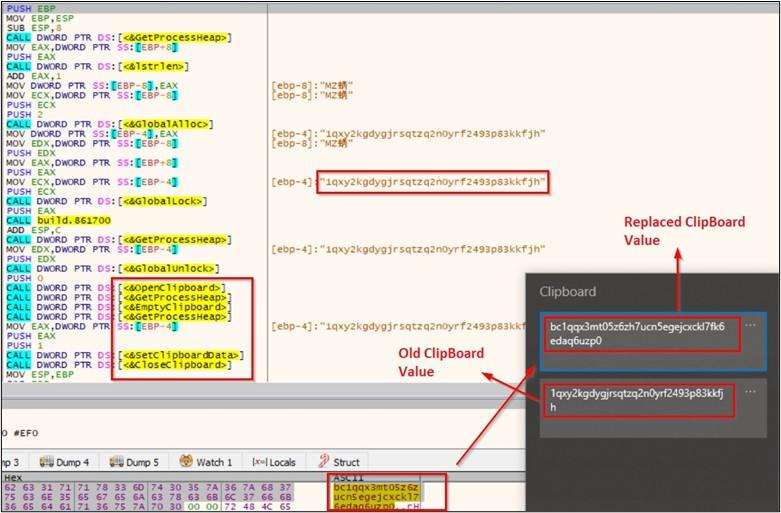
Clipboard hijacker malware is malicious software that monitors the clipboard of a compromised device.
When a user copies a cryptocurrency wallet address, the malware may detect the copied address and replace it with another address.
The victim may then paste the altered address without noticing the difference.
For cryptocurrency transactions, this can be particularly dangerous because wallet addresses can be long strings of letters and numbers. A victim may recognize the general appearance of an address without checking every character.
The result can be:
Legitimate wallet address copied → malware detects address → address replaced → victim pastes altered address → cryptocurrency sent to attacker-controlled address.
This is why clipboard hijacker recovery requires careful examination of both the address the victim intended to use and the address that actually received the cryptocurrency.
The investigation can compare the two addresses and then examine the blockchain transaction to determine what happened after the transfer.
How a Clipboard Hijacker Works
Understanding the attack mechanism is an important part of clipboard hijacker recovery.
The typical sequence can look like this:
Step 1 – The Victim Copies an Address
The victim copies a cryptocurrency wallet address from an exchange, another wallet, an invoice, an email, a website, or another source.
Step 2 – Malware Detects the Clipboard Activity
Malicious software running on the device detects that the copied information resembles a cryptocurrency address.
Step 3 – The Address Is Replaced
The malware replaces the copied address with another address.
Step 4 – The Victim Pastes the Address
The victim pastes the replacement address into their wallet or exchange.
Step 5 – The Transaction Is Sent
The cryptocurrency is sent to the substituted address.
Step 6 – The Victim Notices the Problem
The intended recipient does not receive the cryptocurrency, or the victim later notices that the receiving address was different from the original.
At this point, clipboard hijacker recovery may involve investigating the actual blockchain transaction and tracing the receiving address.
How Do You Get Clipboard Hijacker Malware?
Clipboard hijacker malware can reach a device through several routes.
Your original product information identifies several common infection pathways, including fake cryptocurrency software, malicious Discord or Telegram links, infected email attachments, cracked software, key generators, and compromised websites.
Fake Crypto Software
Attackers may distribute fraudulent applications that appear to be legitimate cryptocurrency wallets, trading tools, portfolio applications, or blockchain utilities.
A user who installs such software may unknowingly install malware.
Malicious Discord Links
Cryptocurrency communities on Discord can be targeted with links to fake downloads, fraudulent promotions, or malicious applications.
Malicious Telegram Links
Telegram groups and direct messages can also be used to distribute suspicious software or links.
If cryptocurrency was stolen after interacting with a Telegram-based scam, our Telegram Crypto Scam Recovery service may also be relevant.
Infected Email Attachments
Malicious attachments can potentially install malware when opened.
Unexpected cryptocurrency-related attachments should be treated cautiously.
Cracked Software and Keygens
Unofficial software downloads and key generators can carry malware.
Installing pirated applications can therefore create security risks beyond the software itself.
Compromised Websites
Some malicious websites may attempt to deliver harmful software through deceptive downloads or other techniques.
Signs You May Have Clipboard Hijacker Malware
Recognizing the signs of a clipboard infection can help prevent additional cryptocurrency losses.
Your supplied page identifies several warning signs, including seeing a different address after pasting, a test transaction failing to arrive, antivirus alerts, and unfamiliar processes running on the device.
The Pasted Address Looks Different
If you copy an address and the address shown after pasting is different, stop immediately.
Do not send the transaction.
A Test Transaction Never Arrives
If you send a small cryptocurrency transaction and it never reaches the intended recipient, investigate the receiving address before sending anything else.
Antivirus Alerts
An antivirus or security application detecting suspicious malware should be taken seriously.
Unfamiliar Processes
Unexpected processes, applications, or system behavior may indicate that the device requires further security investigation.
If cryptocurrency has already been transferred, clipboard hijacker recovery can focus on the blockchain evidence while the device itself is being secured.
How Common Are Clipboard Hijackers?
Clipboard hijacking is an established form of cryptocurrency-related malware.
Your original product page describes clipboard hijackers as an older class of crypto malware and notes that variants may target particular cryptocurrencies or multiple cryptocurrency address formats.
Rather than relying on a specific numerical estimate of victims or losses, each clipboard hijacker recovery investigation should focus on the individual transaction evidence available.
The important question is not simply how common the malware is.
The important questions are:
- What address did you intend to use?
- What address actually received the funds?
- What transaction transferred the funds?
- What happened after the initial transfer?
- Did the receiving address send the cryptocurrency elsewhere?
- Did the funds eventually reach a known exchange or service?
- Is there sufficient evidence to continue tracing the movement?
Can Cryptocurrency Stolen by a Clipboard Hijacker Be Recovered?
Sometimes an investigation may identify useful tracing leads, but recovery cannot be guaranteed.
The original product page states that stolen funds may be traced on the blockchain and that an exchange destination could potentially become an escalation point.
However, identifying a receiving address does not automatically give an investigator control over that wallet.
Likewise, finding an exchange-associated destination does not automatically mean that an account can be frozen or that funds will be returned.
This is why responsible clipboard hijacker recovery focuses first on evidence and tracing.
Potential outcomes can depend on:
- How quickly the theft was reported
- Whether the cryptocurrency remains traceable
- Whether the attacker moved the assets
- Whether multiple wallets were used
- Whether decentralized exchanges were involved
- Whether cross-chain transfers occurred
- Whether the funds reached a centralized exchange
- Whether an exchange can identify the relevant account
- Applicable legal or compliance procedures
- The quality of the evidence supplied
Our service therefore does not promise a specific recovery result.
Act Immediately After a Clipboard Hijacker Attack
If you suspect clipboard hijacker malware, stop using the affected device for cryptocurrency transactions.
Your supplied page recommends not sending additional cryptocurrency from the compromised computer, running a full antivirus scan, changing passwords from a clean device, and contacting the service.
1. Stop Sending Cryptocurrency
Do not make additional cryptocurrency transactions from a device you believe may be infected.
2. Disconnect and Secure the Device
Follow appropriate cybersecurity procedures to investigate and remove the malware.
3. Use a Clean Device
If passwords need to be changed, use a trusted device that is not suspected of being infected.
4. Preserve Evidence
Do not delete important information before documenting it.
Preserve:
- Transaction hashes
- Wallet addresses
- Screenshots
- Emails
- Messages
- Website addresses
- Exchange records
- Antivirus alerts
- Relevant timestamps
- Intended recipient information
5. Begin Blockchain Tracing
Once the transaction information is available, clipboard hijacker recovery can focus on tracing the actual receiving address.
Our Clipboard Hijacker Recovery Process
Step 1 – Initial Case Assessment
The first stage involves reviewing the basic circumstances of the incident.
Useful information includes:
- Intended wallet address
- Actual receiving address
- Transaction hash
- Blockchain network
- Cryptocurrency involved
- Date and approximate time
- Screenshots
- Device information
- Evidence of malware
- Relevant communications
You can begin by visiting our Case Evaluation page.
Step 2 – $99 Case Evaluation
The product information specifies a $99 case evaluation.
The evaluation can be used to examine the available transaction information and determine whether further blockchain investigation is appropriate.
Step 3 – Transaction Tracing
The transaction hash and receiving address can be examined to reconstruct the movement of the stolen cryptocurrency.
A clipboard hijacker recovery investigation may follow subsequent transfers where blockchain data permits.
Step 4 – Wallet Movement Analysis
The receiving address can be reviewed for subsequent transactions.
Investigators may examine whether funds were:
- Consolidated
- Split between multiple addresses
- Swapped for another token
- Sent through a decentralized exchange
- Bridged to another blockchain
- Deposited to an exchange
Step 5 – Exchange Exposure Analysis
If the transaction pathway reaches an identifiable exchange-associated destination, this can become an important investigative lead.
Potential destinations may include Binance, Coinbase, Kraken, or another cryptocurrency service.
Exchange identification does not itself establish the identity of the person controlling the account.
Step 6 – Investigation Report
The findings can be organized into a structured report showing relevant transactions, addresses, movement pathways, and investigative observations.
Step 7 – Further Escalation
Depending on the findings, appropriate next steps may include contacting an exchange, reporting the incident, consulting legal professionals, or providing information to relevant authorities.
Blockchain Tracing in Clipboard Hijacker Recovery
Blockchain tracing is one of the most important components of clipboard hijacker recovery.
When a victim sends cryptocurrency to an attacker-controlled address, the blockchain may preserve the transaction history.
For example:
Victim Wallet → Attacker Address → Second Wallet → Token Swap → Exchange Deposit
The exact pathway will differ from case to case.
An investigation can therefore begin with the known transaction and follow subsequent movements where the available blockchain data permits.
This may reveal:
- Additional receiving addresses
- Transaction timing
- Token conversions
- Wallet relationships
- Exchange-associated destinations
- Cross-chain transfers
- Repeated transaction patterns
Blockchain tracing does not necessarily identify a person’s real-world identity.
It identifies blockchain activity.
Clipboard Hijacker Recovery for Bitcoin
Bitcoin is frequently targeted by cryptocurrency malware because Bitcoin addresses are commonly copied and pasted during transactions.
If malware replaces a Bitcoin address, the transaction can be investigated by examining:
- Sending address
- Intended receiving address
- Actual receiving address
- Transaction ID
- Block information
- Subsequent transactions
- Receiving wallet activity
If the incident involves stolen BTC, our Stolen Bitcoin Recovery service provides a related investigation option.
For clipboard hijacker recovery, the most important starting evidence is the actual transaction hash and the addresses involved.
Clipboard Hijacker Recovery for Ethereum
Ethereum users can also experience address-replacement attacks.
An investigation may involve ETH or ERC-20 tokens.
Depending on the incident, analysts may examine:
- ETH transfers
- ERC-20 transfers
- Contract interactions
- Receiving addresses
- Token swaps
- Decentralized exchange activity
- Subsequent wallet movement
If the incident involves malicious contracts rather than address replacement, our Smart Contract Fraud Investigation service may be relevant.
Clipboard Hijacker Recovery for USDT and Stablecoins
Stablecoins can also be involved in address-replacement incidents.
The investigation needs to identify which blockchain network was used.
For example, USDT can exist on different networks, including Ethereum and TRON.
The transaction hash, token contract, sending address, receiving address, and network are therefore important.
A clipboard hijacker recovery investigation involving stablecoins may need to follow the asset through multiple transactions and potentially across different services.
Clipboard Hijacker Recovery for Exchange Transfers
Sometimes the attacker may eventually send stolen cryptocurrency to a centralized exchange.
Potential exchange destinations can include:
Additional exchange resources include:
If blockchain analysis identifies an exchange-associated destination, the transaction information can potentially be provided to the relevant exchange through its reporting or compliance channels.
A clipboard hijacker recovery investigation should document the evidence rather than promise that an exchange will freeze or return funds.
What Information Do We Need?
The original product page identifies the intended address, actual address, transaction hash, and transaction date as important information.
For a stronger clipboard hijacker recovery assessment, provide as much of the following as possible:
Intended Address
The address you originally copied.
Actual Receiving Address
The address shown in the completed transaction.
Transaction Hash
The blockchain transaction identifier.
Cryptocurrency
For example:
- BTC
- ETH
- USDT
- USDC
- BNB
- SOL
- Other supported digital assets
Blockchain Network
For example:
- Bitcoin
- Ethereum
- TRON
- BNB Chain
- Polygon
Date and Time
The approximate time the transaction was sent.
Supporting Evidence
Screenshots, emails, messages, wallet records, exchange records, and other relevant information can help establish the incident.
Clipboard Hijacker Recovery and Malware Removal
Blockchain tracing addresses the cryptocurrency transaction.
It does not automatically remove malware from the victim’s device.
If you believe the device is infected, cybersecurity remediation should be treated as a separate priority.
Before making additional transactions, consider:
- Running updated security software
- Removing suspicious applications
- Updating operating-system software
- Changing passwords from a clean device
- Enabling multi-factor authentication where appropriate
- Reviewing browser extensions
- Checking for suspicious startup programs
- Avoiding cracked software
- Avoiding unknown wallet applications
If the device remains infected, additional cryptocurrency transactions may be exposed to further theft.
How to Prevent Clipboard Hijacker Attacks
Prevention is an important part of cryptocurrency security.
Your original product recommends verifying the full pasted address, sending a small test transaction, using a hardware wallet with an address display, and keeping antivirus software updated.
Verify the Full Address
Do not assume that the first or last few characters are enough.
Check the address carefully before confirming a transaction.
Send a Test Transaction
For larger transfers, consider sending a small test transaction first when appropriate.
Use a Hardware Wallet
Hardware wallets can provide an additional verification screen for transaction details.
Keep Security Software Updated
Updated security tools can help detect known malicious software.
Avoid Pirated Software
Cracked applications and key generators can expose devices to malware.
Be Careful With Telegram and Discord Links
Do not install cryptocurrency software simply because someone in a chat group recommends it.
Avoid Unknown Wallet Applications
Download wallet software from verified official sources.
Why Choose Our Clipboard Hijacker Recovery Service?
Our clipboard hijacker recovery service is structured around investigation and blockchain intelligence.
Blockchain Transaction Analysis
We examine transaction records associated with the suspected theft.
Wallet Tracing
Relevant wallet activity can be mapped to determine where cryptocurrency moved.
Evidence Organization
Transaction information can be organized into a structured investigative record.
Exchange Exposure Analysis
Where appropriate, investigators can identify potential exchange-associated destinations.
Confidential Case Handling
Information supplied for an investigation should be handled carefully and only used for appropriate investigative purposes.
No Recovery, No Fee
The product is marketed with a no recovery, no fee model. The exact terms applicable to any engagement should be confirmed before work begins.
The original product also specifies a 20% success-based fee in cases where recovery occurs.
About the Published Case Study
The supplied product page contains a case study describing a victim who allegedly lost 3.2 BTC after malware replaced a Bitcoin address, with the transaction reportedly traced to a Binance deposit address and a portion subsequently recovered.
Because the supplied page does not provide independent documentation verifying those results, this information should be treated as a company-provided case study rather than an independently verified recovery result.
For responsible marketing, recovery examples should not be presented as a guarantee that another victim will receive the same outcome.
Clipboard Hijacker Recovery: Tracing vs. Recovering
There is an important difference between tracing stolen cryptocurrency and recovering stolen cryptocurrency.
Tracing
Tracing involves following blockchain transactions and documenting the movement of cryptocurrency.
Identification
Identification may involve determining whether a transaction reaches a known exchange, service, or other identifiable blockchain entity.
Recovery
Recovery means the victim actually receives cryptocurrency back.
These are separate stages.
A successful tracing investigation does not necessarily result in successful recovery.
This distinction is central to responsible clipboard hijacker recovery services.
Frequently Asked Questions
What is clipboard hijacker recovery?
Clipboard hijacker recovery is the investigation of cryptocurrency stolen after malware replaces a copied wallet address with another address controlled by an attacker.
How does a clipboard hijacker steal crypto?
The malware monitors clipboard activity, detects a cryptocurrency address, replaces it with another address, and causes the victim to paste the altered address into a wallet or exchange.
How can I tell if my clipboard has been hijacked?
If the address you paste differs from the address you copied, stop the transaction immediately. Other warning signs can include failed transfers, antivirus warnings, and unfamiliar processes.
Can you trace cryptocurrency stolen by clipboard malware?
Blockchain transactions can often be analyzed to determine where cryptocurrency was sent and where it moved afterward.
Can you guarantee recovery?
No. Clipboard hijacker recovery can provide tracing and investigative analysis, but recovery depends on circumstances outside the blockchain tracing process.
What information do I need?
The intended address, actual receiving address, transaction hash, cryptocurrency, blockchain network, date, and supporting evidence are useful starting points.
How long does clipboard hijacker recovery take?
The investigation timeline depends on transaction complexity, the number of wallets involved, the blockchain networks involved, and whether additional tracing is necessary. No fixed recovery timeline should be guaranteed.
What happens if the attacker uses many wallets?
Multiple wallet transfers can make tracing more complicated, but transaction mapping can be used to follow relevant blockchain activity where the data permits.
What if the funds reach an exchange?
An exchange-associated address can become an investigative lead. Relevant transaction evidence may be provided to the exchange through appropriate reporting channels.
What if the funds go through a mixer?
Mixing services can significantly complicate blockchain tracing. The availability of useful investigative evidence depends on the specific transaction pathway.
Is the $99 evaluation refundable?
The original product page states that the $99 fee is refundable if the case is considered unrecoverable. Confirm the current refund terms before purchasing.
Do I need to share my private key?
No. Never share your private key or seed phrase.
The original page specifically states that transaction hashes and addresses are sufficient for the investigation.
Can I still use my computer after the malware attack?
If you believe the computer is infected, avoid making additional cryptocurrency transactions until the device has been secured.
Related Crypto Recovery Services
If your cryptocurrency theft involved another type of attack, the following services may also be relevant:
Fake Crypto Exchange Recovery
Fake Exchange & Fake Wallet App Recovery – Trace Stolen Crypto
Fake Investment Scam Recovery
Fake Investment Scam Recovery – Guaranteed Profit & Trading Bot Fraud
Crypto Phishing Recovery
Phishing Attack Recovery – Stolen Crypto from Fake Websites & Fake Links
Blockchain Forensic Investigation
Blockchain Forensic Investigation
Crypto Hack Address Recovery
Crypto Hack Address Recovery & Blockchain Asset Tracing
Important Security Warning
A cryptocurrency theft can be followed by a second scam.
After losing funds, victims may receive messages from people claiming they can recover the cryptocurrency.
Be extremely careful if someone:
- Contacts you unexpectedly
- Guarantees recovery
- Requests your seed phrase
- Requests your private key
- Requests remote access to your wallet
- Claims to have already frozen funds
- Requests cryptocurrency before providing evidence
- Demands a payment to “unlock” recovered funds
- Claims to be an exchange employee without verification
Legitimate investigative work should not require you to surrender control of your wallet.
You can review our Disclaimer and AML Compliance Policy for additional information.
Start Your Clipboard Hijacker Recovery Investigation
If you copied a cryptocurrency address, pasted it into your wallet, completed the transaction, and later discovered that the cryptocurrency went to another address, you may have experienced a clipboard hijacking attack.
Do not send additional cryptocurrency from a device you believe is infected.
Preserve your transaction hash, wallet addresses, screenshots, and other evidence.
Our clipboard hijacker recovery service can help investigate the blockchain transaction, analyze the receiving address, trace subsequent cryptocurrency movement, identify potential exchange exposure, and organize the available findings.
Begin with our $99 Case Evaluation.
You can also visit our About Us page to learn more about the company.
For questions about the service, use our Contact Us page.
Top 10 Crypto Exchange Resources
If your blockchain investigation identifies a destination associated with a centralized exchange, the following official websites may be useful resources:
These links are provided as official exchange resources. An exchange appearing in a blockchain transaction pathway does not by itself establish that the exchange caused the theft or that a particular customer controlled the destination account.
Useful Crypto Reverse Transaction Resources
For additional assistance and information:
- Crypto Reverse Transaction Homepage
- Our Services
- Case Evaluation
- Case Consultation
- Frequently Asked Questions
- Success Stories
- Privacy Policy
- Refund Policy
- Terms & Conditions
Final CTA
Was Your Cryptocurrency Sent to the Wrong Address?
If malware changed the cryptocurrency address you copied and your funds were sent to an unknown wallet, act quickly.
Our clipboard hijacker recovery service can investigate the transaction, analyze the receiving address, trace subsequent blockchain activity, and identify potential investigative leads.
Start with the $99 case evaluation and provide the transaction information you have available.
Start Your $99 Case Evaluation
Never share your seed phrase or private key with anyone claiming they can recover your cryptocurrency. Clipboard hijacker recovery


Reviews
There are no reviews yet.