
Description
DeFi Exploit Investigation for Hacked Protocols and Stolen Cryptocurrency
Decentralized finance has created an ecosystem where users can trade, lend, borrow, stake, provide liquidity and interact with smart contracts without relying on traditional financial institutions. However, the same technology that makes decentralized applications powerful can also create opportunities for attackers when contracts, administrative controls, bridges, or connected infrastructure contain vulnerabilities.
When a DeFi protocol is exploited, the first challenge is understanding exactly what happened.
A DeFi exploit investigation focuses on reconstructing the incident from available evidence, examining blockchain transactions, identifying suspicious addresses, following asset movements and determining what additional information may be available for further investigation.
Ethereum’s official security documentation explains that smart contracts can control significant amounts of value and that vulnerabilities can expose those assets to attackers. It also notes that assets stolen through vulnerable smart contracts can be extremely difficult to recover because blockchain transactions are designed around immutability.
If your organization or project has experienced a suspected exploit, you can begin by requesting a [Case Evaluation]Case Evaluation and providing the transaction hashes, wallet addresses, contract addresses and other information available to you.
What Is a DeFi Exploit Investigation?
A DeFi exploit investigation is a structured examination of a suspected attack involving decentralized finance infrastructure.
The investigation may examine:
- Smart contracts
- DeFi protocols
- Token transfers
- Liquidity pools
- Wallet addresses
- Bridge transactions
- Contract interactions
- Approval transactions
- Suspicious transactions
- Exchange deposits
- Cross-chain movements
- Transaction timing
- Attack vectors
- Related addresses
- On-chain relationships
The objective is to establish a chronological and evidence-based picture of the incident.
This distinction is important because tracing is not the same thing as recovery.
A blockchain investigator may be able to establish that assets moved from one wallet to another. That does not automatically mean the person controlling the destination wallet has been identified, nor does it guarantee that an exchange or other intermediary will freeze funds.
For this reason, our [Blockchain Forensic Investigation]Blockchain Forensic Investigation service can be relevant when a more detailed transaction analysis is required.
Why DeFi Exploits Can Be Difficult to Investigate
DeFi incidents can involve multiple transactions and multiple blockchain networks.
An attacker may move assets between wallets, swap one token for another, interact with decentralized applications or bridge assets to another blockchain. Each transaction creates another part of the investigative timeline.
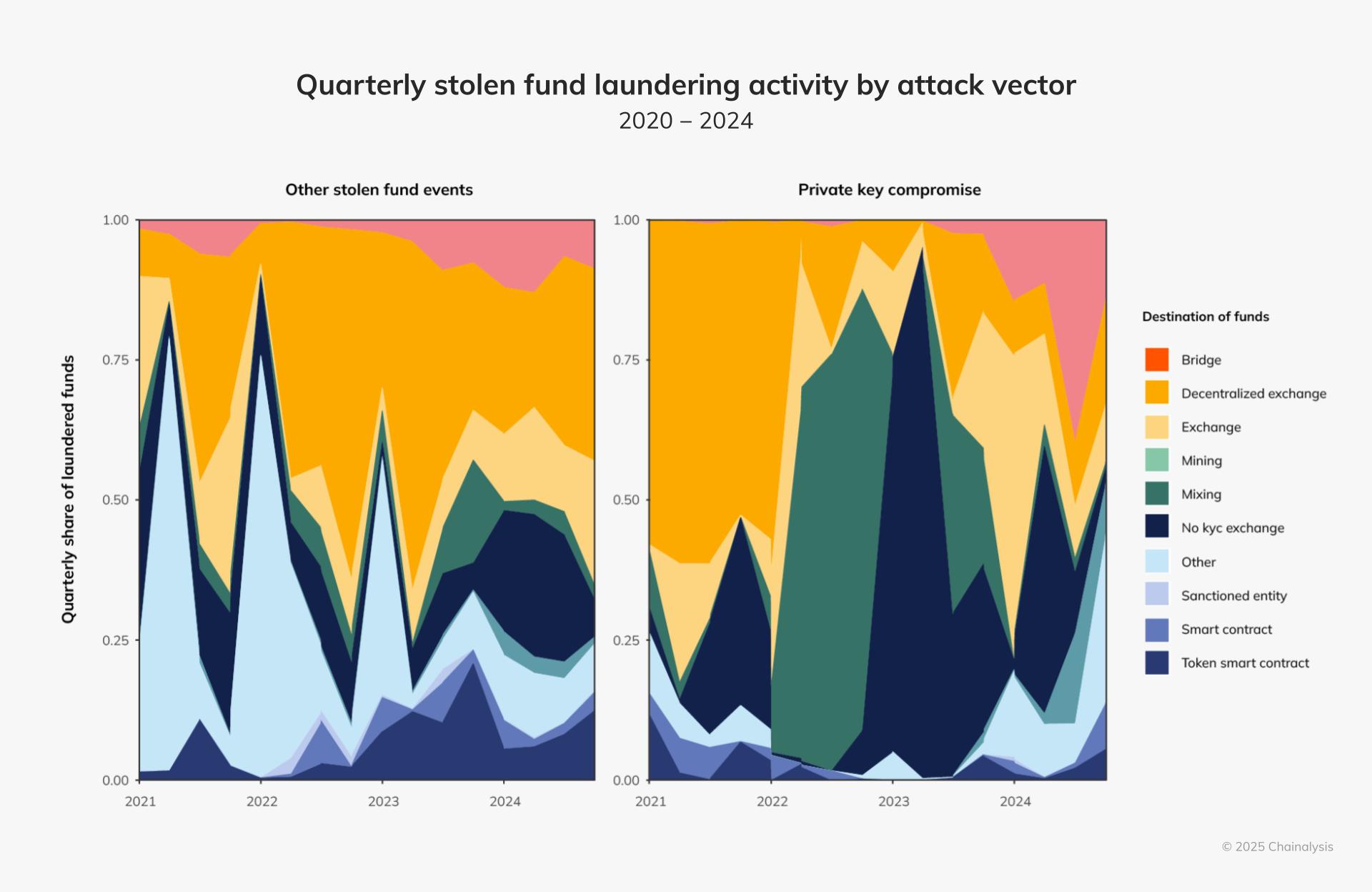
Chainalysis’ 2026 Crypto Crime Report specifically discusses evolving crypto crime involving DeFi exploits and cross-chain criminal activity, illustrating why blockchain investigations increasingly require analysis across multiple transaction environments.
A single suspicious transaction therefore may not tell the entire story.
For example, an investigation might begin with:
Victim wallet → attacker wallet → token swap → second wallet → bridge → another blockchain → exchange deposit
Each stage can require separate examination.
That is why our [Crypto Asset Tracing Services]Crypto Asset Tracing Services can be used alongside a broader DeFi exploit investigation when the primary objective is understanding where assets moved after the initial incident.
Common Types of DeFi Exploits
1. Flash Loan Attacks
Flash loans allow users to borrow assets without traditional collateral, provided the transaction is completed within the same transaction sequence.
The technology itself is not inherently fraudulent. The problem occurs when weaknesses in a DeFi protocol’s logic or pricing mechanism allow borrowed liquidity to manipulate a system.
An investigation may examine:
- The initial borrowing transaction
- Contract interactions
- Price changes
- Liquidity movements
- Token swaps
- Profit extraction
- Destination wallets
Understanding the complete transaction sequence is essential because individual transfers can be misleading when viewed without the surrounding contract activity.
2. Reentrancy Exploits
Reentrancy vulnerabilities can occur when a smart contract makes an external call before properly updating internal state.
Ethereum’s security documentation identifies reentrancy as one of the important classes of smart-contract vulnerabilities that developers need to understand and defend against.
During a DeFi exploit investigation, investigators may examine the order of contract calls and determine whether repeated interactions occurred during a vulnerable execution sequence.
This may involve analyzing:
- Contract functions
- Event logs
- Internal transactions
- Token transfers
- Call sequences
- Block numbers
- Gas usage
- Destination addresses
Where appropriate, our [Smart Contract Fraud Investigation]Smart Contract Fraud Investigation service can complement the broader blockchain analysis.
3. Price Oracle Manipulation
Many DeFi applications depend on price information to determine the value of assets.
If a protocol relies on an improperly designed or insufficiently protected price mechanism, an attacker may attempt to manipulate the information used by the protocol.
A DeFi exploit investigation can examine the transactions surrounding the suspected manipulation and compare relevant on-chain events.
The analysis may include:
- Liquidity changes
- Token swaps
- Oracle-related transactions
- Contract calls
- Borrowing activity
- Liquidations
- Asset transfers
The purpose is not simply to identify a suspicious wallet but to reconstruct the sequence of events that caused the loss.
4. Bridge Exploits
Cross-chain bridges can introduce additional technical complexity because they connect different blockchain environments.
A bridge-related incident may involve:
Chain A → bridge contract → intermediary mechanism → Chain B → destination wallet
Investigators therefore need to examine both sides of the transaction flow.
Cross-chain tracing can become especially important when stolen assets leave the original blockchain.
Our [Crypto Asset Tracing Services]Crypto Asset Tracing Services can be relevant when the investigation involves multiple networks.
5. Compromised Administrative or Privileged Keys
Not every DeFi incident results from a coding vulnerability.
A project may experience a compromise involving an administrative wallet, privileged account or other key capable of performing sensitive operations.
Ethereum’s security guidance highlights access controls and the importance of protecting privileged accounts because compromise of administrative keys can expose smart contracts to attacks.
A DeFi exploit investigation can therefore examine whether suspicious administrative transactions occurred before the loss.
This may involve looking for:
- Ownership transfers
- Permission changes
- Contract upgrades
- Emergency functions
- Minting events
- Treasury withdrawals
- Unusual administrative calls
6. Logic and Contract Design Vulnerabilities
Smart contracts are software, and software can contain design and implementation errors.
Ethereum recommends extensive testing, independent review and other security practices because audits and testing cannot guarantee that every vulnerability will be discovered.
When investigating a suspected exploit, it can therefore be useful to combine blockchain transaction analysis with examination of the affected contract’s behavior.
Our [DeFi Exploit Investigation service]DeFi Exploit Investigation Service is designed around investigating these types of incidents rather than assuming every loss has the same cause.
What Information Is Needed for a DeFi Exploit Investigation?
The more reliable information available at the beginning of an investigation, the easier it may be to establish a transaction timeline.
Useful information can include:
- Victim wallet address
- Transaction hash
- Blockchain network
- Token contract address
- Attacker wallet address, if known
- DeFi protocol name
- Smart-contract address
- Approximate date and time
- Amount lost
- Screenshots
- Wallet transaction history
- Exchange information
- Bridge information
- Relevant communications
- Security alerts
- Incident reports
Do not send private keys, seed phrases or wallet passwords.
A legitimate investigation should not require you to disclose sensitive wallet credentials.
If you are unsure what evidence is relevant, you can start with our [Case Consultation]Case Consultation.
Our DeFi Exploit Investigation Process
Step 1: Initial Case Review
The first stage is understanding what happened.
We review the information supplied about the incident and identify the blockchain, transaction hashes, addresses, tokens and protocol involved.
This initial review helps determine whether there is sufficient information to conduct a deeper investigation.
Step 2: Transaction Analysis
The next stage involves examining the relevant blockchain activity.
Transactions may be organized chronologically to identify:
- Initial exploit transaction
- Asset transfers
- Token swaps
- Wallet-to-wallet movements
- Contract interactions
- Cross-chain transfers
- Exchange deposits
Blockchain transactions provide important evidence because public blockchains record transaction activity permanently.
However, the identity behind an address generally cannot simply be determined from the address itself.
Step 3: Wallet Relationship Analysis
A DeFi exploit investigation may identify relationships between addresses based on observable transaction behavior.
For example, several wallets may appear connected because they repeatedly interact with the same contracts or move assets through the same transaction sequence.
These relationships should be treated as investigative leads rather than automatic proof that the same individual controls every address.
This distinction is particularly important when preparing evidence for legal, compliance or law-enforcement purposes.
Step 4: Cross-Chain Analysis
If stolen assets move from one blockchain to another, the investigation may continue across the destination network.
Cross-chain analysis can involve:
- Identifying bridge transactions
- Matching transaction timing
- Tracking equivalent assets
- Identifying destination wallets
- Following subsequent transfers
- Examining exchange deposits
Chainalysis’ 2026 reporting highlights the growing importance of cross-chain analysis in understanding modern crypto crime.
Step 5: Exchange Destination Analysis
One of the important investigative developments is identifying whether stolen assets eventually reach a centralized cryptocurrency exchange.
Potential exchange destinations can become relevant because regulated or centralized platforms may have compliance processes and account-level information that is not visible directly on a public blockchain.
However, identifying an exchange deposit does not automatically mean that funds will be frozen or returned.
The appropriate next step depends on the evidence and the platform involved.
For example, exchanges that may appear in an investigation can include Coinbase, Binance, Kraken or Gemini.
Step 6: Evidence Organization
A useful investigation should not simply produce a list of wallet addresses.
The evidence should be organized so that another person can understand:
- What happened.
- When it happened.
- Which addresses were involved.
- Where assets moved.
- Which transactions are relevant.
- Which findings are confirmed.
- Which findings remain investigative leads.
For more detailed evidence work, our [Blockchain Forensic Investigation service]Blockchain Forensic Investigation may be relevant.
Step 7: Recovery and Escalation Strategy
A DeFi exploit investigation can identify potential recovery pathways, but recovery itself is a separate challenge.
Possible next steps may include:
- Exchange compliance notification
- Law-enforcement reporting
- Legal consultation
- Platform reporting
- Continued blockchain monitoring
- Evidence preservation
- Civil recovery options where appropriate
Our [Case Evaluation]Case Evaluation can help determine what information is available before deciding on further action.
Why Blockchain Transparency Matters
One of the unusual characteristics of cryptocurrency is that many public blockchain transactions remain visible after the incident.
This means that even after assets leave the victim’s wallet, investigators may continue examining subsequent transaction activity.
That does not make stolen cryptocurrency automatically recoverable.
Instead, blockchain transparency creates a source of evidence that may help investigators reconstruct the movement of assets.
Chainalysis describes blockchain transparency as an important component of financial-crime investigation and asset tracing.
DeFi Exploit Investigation vs. Crypto Recovery
These terms should not be confused.
DeFi Exploit Investigation
An investigation focuses on determining:
- What happened?
- Which contracts were involved?
- Which wallets received the assets?
- How did the assets move?
- Did the assets cross chains?
- Did they reach an identifiable intermediary?
Crypto Recovery
Recovery concerns what can actually be done after the assets have been traced.
That can depend on:
- Whether the funds remain accessible
- Whether they reached a centralized platform
- Whether an intermediary can identify an account
- Whether legal processes are available
- Whether law enforcement is involved
- Whether the attacker still controls the assets
Our [Crypto Recovery service]Crypto Recovery Service can be considered when an investigation has identified a potential recovery pathway.
What a DeFi Exploit Investigation Cannot Guarantee
It is important to maintain realistic expectations.
A professional DeFi exploit investigation cannot honestly guarantee:
- That stolen cryptocurrency will be recovered
- That an attacker will be identified
- That an exchange will freeze funds
- That a wallet owner will be identified
- That law enforcement will pursue a case
- That a blockchain transaction can be reversed
Public blockchain analysis can establish transaction activity, but it does not automatically reveal the real-world identity behind every address.
Similarly, a destination at a centralized exchange is an investigative lead rather than proof that the exchange account belongs to the person who initiated the original theft.
What You Should Do Immediately After a DeFi Exploit
If you believe a DeFi protocol has been exploited, preserve evidence before deleting anything.
Save:
- Transaction hashes
- Wallet addresses
- Contract addresses
- Screenshots
- Token information
- Emails
- Messages
- Security alerts
- Protocol announcements
- Exchange correspondence
- Relevant dates and times
Do not attempt to retaliate against the attacker or attempt unauthorized access to another wallet.
Do not send additional cryptocurrency to someone claiming that a payment is required to “unlock” your stolen funds unless you have independently verified the claim.
And never provide your seed phrase or private keys to an investigator, exchange representative, recovery company or stranger.
For additional information about responsible handling of investigations, you can review our [AML Compliance Policy]AML Compliance Policy and [Disclaimer]Disclaimer.
DeFi Security and Prevention
A DeFi exploit investigation is reactive. Strong security practices are preventative.
Project developers should consider:
- Independent smart-contract reviews
- Extensive testing
- Access-control protections
- Multi-signature administration
- Monitoring systems
- Incident-response procedures
- Secure key management
- Emergency procedures
Ethereum’s security documentation recommends testing, independent review and appropriate access controls as part of a broader smart-contract security strategy.
Ethereum also explains that source-code verification allows users and developers to compare published source code with the code deployed at a contract address.
Why Choose Crypto Reverse Transaction?
Crypto Reverse Transaction focuses on blockchain-related investigations involving stolen, inaccessible or disputed cryptocurrency.
Depending on the circumstances, our services can involve:
- Blockchain transaction analysis
- Crypto asset tracing
- DeFi exploit investigation
- Smart-contract investigation
- Wallet investigation
- Scam investigation
- Cross-chain transaction analysis
- Evidence organization
You can learn more about our company through our [About Us]About Us page or review our [Success Stories]Success Stories for information published on our website.
For information about how submitted information is handled, review our [Privacy Policy]Privacy Policy and [Terms & Conditions]Terms & Conditions.
Start a DeFi Exploit Investigation
If your protocol, wallet or organization has experienced a suspected DeFi exploit, early evidence preservation can be important.
Start by collecting the relevant transaction hashes, wallet addresses, contract addresses and other available documentation.
Then submit the information through our [Case Evaluation]Case Evaluation page.
A professional DeFi exploit investigation can help organize the available blockchain evidence, reconstruct asset movements and identify potential investigative leads.
The investigation does not guarantee recovery, but it can provide a clearer understanding of what happened and what options may be available based on the evidence.
Frequently Asked Questions About DeFi Exploit Investigation
What is a DeFi exploit investigation?
A DeFi exploit investigation is an examination of a suspected decentralized-finance attack. It can involve analyzing smart-contract interactions, wallet addresses, transaction histories, token movements and cross-chain activity.
Can stolen DeFi funds be recovered?
Recovery is sometimes possible, but it cannot be guaranteed. Blockchain transactions are generally irreversible, and the ability to recover assets depends heavily on where the assets moved and what evidence is available.
Can you identify the person behind a crypto wallet?
Blockchain analysis can identify transaction activity and relationships between addresses, but a blockchain address does not automatically reveal a person’s real-world identity.
What information should I provide?
Transaction hashes, wallet addresses, contract addresses, blockchain names, token information, screenshots and relevant incident records can be useful.
Never provide your seed phrase or private keys.
Can you trace cryptocurrency across multiple blockchains?
Cross-chain investigations can examine asset movements across supported blockchain networks and identify transactions that may connect different stages of an incident.
Can an exchange freeze stolen cryptocurrency?
An exchange may have its own compliance and law-enforcement procedures, but identifying stolen funds at an exchange does not guarantee that the funds will be frozen or returned.
Does a DeFi exploit investigation guarantee recovery?
No. A legitimate investigation should not promise guaranteed recovery. Investigation and recovery are separate processes.
How do I start?
You can begin through our [Case Evaluation]Case Evaluation page or contact us through [Contact Us]Contact Us.
Top 10 Crypto Exchanges and Official Resources
The following are major cryptocurrency exchange websites that may be relevant when researching exchange deposits, account procedures, compliance information or reporting channels. Their inclusion does not imply that any particular exchange is connected to a specific incident.
1. Binance
Binance is a major global cryptocurrency exchange. If blockchain tracing indicates that assets may have reached a Binance-controlled address, the relevant transaction evidence should be preserved before making a report.
2. Coinbase
Coinbase provides cryptocurrency trading and custody services. Investigators may examine whether traced assets appear to have entered Coinbase-controlled infrastructure.
3. Kraken
Kraken is another established cryptocurrency exchange that may appear in transaction investigations depending on the blockchain and assets involved.
4. OKX
OKX provides cryptocurrency exchange and digital-asset services across multiple markets.
5. Bybit
Bybit is a major cryptocurrency trading platform. Its website provides information about its services and relevant user procedures.
6. Crypto.com
Crypto.com provides cryptocurrency trading and related digital-asset services.
7. Gemini
Gemini provides cryptocurrency trading and custody services and can be relevant when an investigation identifies a potential exchange destination.
8. Bitfinex
Bitfinex is a cryptocurrency trading platform that may be relevant to certain transaction investigations.
9. Bitstamp
Bitstamp provides cryptocurrency exchange services and has operated in the digital-asset industry for many years.
10. KuCoin
KuCoin is a cryptocurrency trading platform that may become relevant when blockchain tracing identifies a potential deposit destination.
Final Thoughts
A DeFi incident can be technically complicated, particularly when stolen assets move through several wallets, smart contracts, decentralized applications, bridges and blockchain networks.
A structured DeFi exploit investigation begins with evidence.
Transaction hashes, wallet addresses, contract addresses and timestamps can help establish what happened and how assets moved. From there, blockchain analysis may reveal additional addresses, transaction relationships and potential exchange destinations.
However, tracing should never be confused with guaranteed recovery.
The strongest approach is to preserve evidence, avoid sending additional funds to unknown parties, never disclose private keys or seed phrases, and obtain a structured assessment of the available information.
If you need to investigate a suspected DeFi exploit, begin with a [Case Evaluation]Case Evaluation and provide the relevant blockchain evidence.
Crypto Reverse Transaction can help you investigate the blockchain activity, organize the available evidence and identify potential next steps based on the facts of your case.


Reviews
There are no reviews yet.