
How to Recover Funds from Pig Butchering Scams
A pig butchering scam can be financially and emotionally devastating. Victims are often approached through dating applications, social media, WhatsApp, Telegram or other online channels and gradually persuaded to trust someone who eventually introduces a fraudulent cryptocurrency investment opportunity.
The scam may continue for weeks or months.
The person may appear caring and trustworthy. They may discuss cryptocurrency, investing, trading or financial independence. Eventually, they encourage the victim to transfer cryptocurrency to a platform or wallet controlled by the scammers.
The website may then display impressive profits.
When the victim attempts to withdraw, the problems begin.
The platform may demand a supposed tax, withdrawal charge, verification payment, liquidity deposit or account-unlocking fee. After additional payments are made, another requirement appears—or the platform disappears completely.
If this has happened to you, the first priority is to stop the financial loss.
The second is to preserve evidence.
The third is to determine where the cryptocurrency actually went.
That is where blockchain tracing can become relevant when attempting to recover funds from pig butchering.
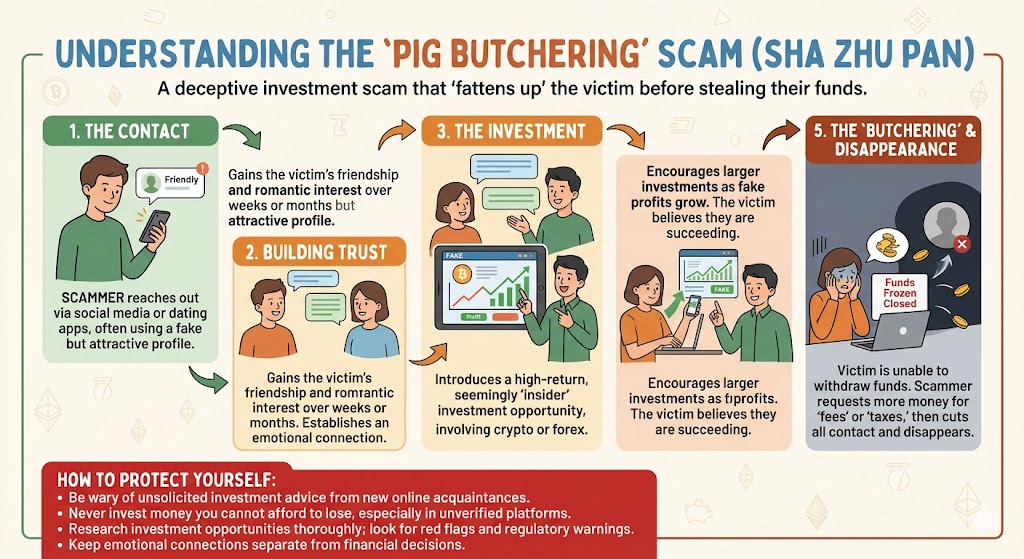
What Is a Pig Butchering Scam?
Pig butchering is a form of long-term confidence and investment fraud.
The scammer generally develops trust before introducing the financial component.
A typical sequence can look like this:
Initial contact → relationship building → discussion of investments → cryptocurrency introduction → fake platform → deposits → fake profits → larger deposits → withdrawal problem → additional fees → disappearance
The FBI has repeatedly warned about cryptocurrency investment fraud involving fake investment platforms and social-engineering tactics. Its guidance notes that victims can be shown fictitious profits and then pressured to send additional funds. FBI Cryptocurrency Investment Fraud Guidance
The term “pig butchering” is commonly associated with this process because the victim is gradually cultivated before the financial theft occurs.
Recognizing the pattern is important because victims sometimes continue sending money after the initial loss, believing that another payment will unlock the supposed investment.
It usually does not.
If your objective is to recover funds from pig butchering, sending more cryptocurrency to the fraudulent platform generally creates another loss rather than solving the original problem.
Stop Sending Money Immediately
If a fake investment platform tells you that you need to pay another amount before withdrawing your cryptocurrency, stop.
Do not send additional funds simply because the website shows a balance.
The displayed balance may not represent cryptocurrency that you can actually withdraw.
Fraudulent investment platforms can display fictitious profits and then demand additional payments.
The FBI advises victims of cryptocurrency investment fraud not to send additional money to fraudulent platforms to pay supposed taxes or fees. FBI Cryptocurrency Investment Fraud Information
This is one of the most important steps when trying to recover funds from pig butchering.
Do not let the promise of recovering the first loss cause a second loss.
Can You Recover Funds from Pig Butchering?
The honest answer is that recovery may be possible in some circumstances, but it is never guaranteed.
The fact that cryptocurrency transactions are recorded on blockchains can provide valuable evidence.
If you sent cryptocurrency from your own wallet to an address controlled by the scammer, the transaction can generally be examined.
Investigators may be able to establish:
- The original transaction
- The recipient wallet
- Subsequent transactions
- Additional destination addresses
- Asset movements
- Potential exchange destinations
- Cross-chain transfers where identifiable
This can help establish what happened after the original payment.
However, tracing the funds does not automatically mean that they can be returned.
That distinction is critical when discussing how to recover funds from pig butchering.
A responsible investigation should explain what the blockchain evidence shows and what recovery pathways may exist without promising a particular outcome.
Why the Cryptocurrency Transaction Matters
The fake investment website may be fraudulent, but the cryptocurrency transaction used to fund it may still exist on a public blockchain.
This creates an important distinction.
The website may disappear.
The scammer may delete messages.
A dating profile may be removed.
A Telegram account may disappear.
But the underlying blockchain transaction may remain recorded.
For example:
Your wallet → scammer wallet
could later become:
Your wallet → scammer wallet → secondary wallet → third wallet → exchange-related destination
The blockchain record can help reconstruct that movement.
The FBI recommends that cryptocurrency victims preserve transaction information such as wallet addresses, cryptocurrency type, amount, date, time and transaction hash when reporting fraud. FBI Cryptocurrency Victim Guidance
That evidence can become important when attempting to recover funds from pig butchering.
Step 1: Preserve Every Transaction
Start by gathering the blockchain information associated with your payments.
Record:
- Transaction hash/TXID
- Sending wallet
- Receiving wallet
- Cryptocurrency
- Network
- Amount
- Date
- Approximate time
If you used an exchange to purchase or send the cryptocurrency, preserve the exchange transaction records as well.
Do not rely only on screenshots.
Whenever possible, record the actual transaction hash and wallet address.
For Bitcoin, Ethereum, USDT, USDC, Solana and other assets, the relevant transaction information can help establish the starting point of an investigation.
Step 2: Preserve the Romance Scam Evidence
Blockchain information is important, but pig butchering cases often contain substantial off-chain evidence.
Preserve:
- Dating-app conversations
- WhatsApp conversations
- Telegram messages
- Emails
- Social-media messages
- Phone numbers
- Usernames
- Profile URLs
- Photos used by the scammer
- Website URLs
- Fake investment-platform information
- Payment instructions
- Screenshots of your account
- Withdrawal messages
- Requests for additional fees
- Names used by the scammer
Do not delete the conversation simply because it is painful to read.
It may help establish the timeline of the fraud.
When trying to recover funds from pig butchering, investigators may need to understand not only where the cryptocurrency went but also how the victim was persuaded to send it.
Step 3: Identify the Original Destination
The next question is:
Where did your cryptocurrency go first?
This may be the wallet address supplied by the scammer or the deposit address associated with the fraudulent platform.
The original destination is an important starting point because later transactions can potentially be traced from there.
For example:
Victim wallet
↓
Scammer-controlled wallet
↓
Wallet 2
↓
Wallet 3
↓
Exchange-related address
Each transfer can potentially provide another piece of the transaction history.
This is why the original transaction should be preserved even if the cryptocurrency has already moved several times.
Step 4: Trace Subsequent Wallet Movements
A blockchain investigation can examine what happened after the initial transfer.
The investigation may look for:
- Direct transfers
- Multiple wallet hops
- Consolidated transactions
- Split transactions
- Token swaps
- Cross-chain movements
- Deposits into services
- Transfers to potential exchange addresses
However, the number of wallet hops should not be used as a guaranteed measure of difficulty.
Some cases with several transactions may be relatively straightforward, while a shorter transaction chain can still present significant attribution challenges.
When trying to recover funds from pig butchering, the important issue is the evidence contained in the actual transaction history.
Step 5: Determine Whether the Funds Reached an Exchange
One potentially important investigative development is identifying whether stolen cryptocurrency reached a centralized exchange.
For example:
Victim → Scammer → Wallet A → Wallet B → Exchange-related destination
If an exchange-related destination can be identified, that information may provide a lead for reporting and further investigation.
But an exchange-related address does not automatically reveal the scammer’s identity.
It also does not mean that a private investigator can independently freeze the account.
The FBI specifically warns that private recovery companies cannot issue seizure orders. Exchanges may freeze accounts through their internal processes or in response to legal process. FBI Recovery Scam Warning
Therefore, when trying to recover funds from pig butchering, exchange identification should be presented as an investigative lead rather than a guaranteed recovery mechanism.
Step 6: Report the Fraud
Victims should consider reporting the underlying crime to the appropriate authorities.
In the United States, cryptocurrency fraud can be reported to the FBI’s Internet Crime Complaint Center.
FBI Internet Crime Complaint Center
The FBI recommends including detailed transaction information when reporting cryptocurrency fraud. FBI Cryptocurrency Victim Guidance
Depending on the circumstances, victims may also need to contact:
- Their cryptocurrency exchange
- Their bank or payment provider
- Local law enforcement
- Relevant financial regulators
- Other organizations involved in the transaction
Reporting does not guarantee recovery, but it creates an official record of the fraud and can preserve information that may become relevant to an investigation.
Step 7: Contact the Relevant Exchange Through Official Channels
If the stolen cryptocurrency appears to have reached an exchange, use the exchange’s official website to determine its fraud-reporting or support process.
Do not use a telephone number or email address supplied by the scammer.
Do not trust someone who contacts you claiming to be an exchange employee and asks for cryptocurrency to unlock an account.
Official exchange resources include:
These links should be used to independently verify official domains and support resources.
Recover Funds from Pig Butchering Involving USDT
USDT is commonly involved in cryptocurrency investment scams, but an investigation needs to establish which blockchain network was used.
For example, a USDT transaction may need to be examined on the relevant network rather than simply described as “a USDT transfer.”
Preserve:
- USDT amount
- Network
- Sending address
- Receiving address
- Transaction hash
- Date and time
Tether provides official information about its supported protocols through its website. Tether Supported Protocols
If your pig butchering loss involved USDT, provide the exact transaction information during an investigation.
Recover Funds from Pig Butchering Involving Bitcoin
Bitcoin cases can often begin with the original transaction hash.
The investigator may then map subsequent transactions and identify how the BTC moved.
A simplified example could look like:
Victim BTC wallet
→ Scammer wallet
→ Intermediate wallet
→ Consolidation wallet
→ Potential service/exchange
The fact that the transactions can be observed does not mean that the owner of each address can automatically be identified.
Nevertheless, transaction mapping can establish a documented trail.
That evidence may become useful for reporting and other investigative steps intended to recover funds from pig butchering.
Recover Funds from Pig Butchering Involving Ethereum
Ethereum-based pig butchering scams may involve ETH or ERC-20 tokens.
The investigation may therefore examine:
- ETH transactions
- Token transfers
- Contract addresses
- Wallet interactions
- Token swaps
- Decentralized applications
- Subsequent destinations
If a victim transferred USDC or another ERC-20 token to a fraudulent investment platform, the token contract and transaction hash can be important evidence.
The investigation should identify the relevant blockchain and asset rather than relying on a generic description of the payment.
Recover Funds from Pig Butchering Involving Solana
Solana-based scams can involve SOL or SPL tokens.
Victims should preserve the relevant transaction signature and wallet information.
Depending on the case, investigators may examine:
- SOL transfers
- SPL token transfers
- Token accounts
- Subsequent wallet activity
- Swaps
- Program interactions
- Potential exchange destinations
As with other networks, the ability to trace activity does not guarantee that assets can be returned.
The objective is to establish the transaction history and identify potential investigative pathways.
Cross-Chain Pig Butchering Cases
Some scammers may move cryptocurrency between blockchain networks.
A simplified example might look like:
USDT → token swap → bridge → another blockchain → different asset → exchange
Cross-chain activity can complicate the investigation because the transaction history no longer exists entirely within one blockchain environment.
A professional investigation may therefore need to correlate information across multiple networks.
If you are trying to recover funds from pig butchering, tell the investigator if you know that the scammer moved the cryptocurrency between different blockchains.
Do not assume that only the original transaction matters.
What If the Fake Investment Platform Shows My Money?
This is one of the most important questions in pig butchering cases.
The website may show a balance of:
$50,000
or:
$250,000
or even:
$1,000,000
But a number displayed on a website does not necessarily represent cryptocurrency that exists in a wallet controlled by you.
The FBI has warned about fraudulent cryptocurrency investment platforms displaying fictitious profits and using withdrawal restrictions and additional payment demands. FBI Cryptocurrency Investment Fraud Guidance
Before attempting to recover funds from pig butchering, determine what cryptocurrency actually left your wallet or exchange account.
The blockchain transaction is more useful evidence than a balance displayed on the fraudulent website.
What If the Scammer Says I Need to Pay a Tax?
Do not automatically pay it.
A fake investment platform may tell you that your account has generated taxable profits and that you must pay a percentage before withdrawing.
It may then request another payment after you pay the first one.
This can continue indefinitely.
The FBI warns victims about these additional-payment tactics and advises against sending more money to fraudulent investment platforms. FBI Cryptocurrency Investment Fraud Guidance
If you have already paid several supposed fees, preserve evidence of each payment.
Those transactions may form part of the overall investigation.
What If the Scammer Uses WhatsApp or Telegram?
Preserve the conversations.
Do not assume that deleting the scammer’s account will erase the evidence you need.
Save:
- Phone number
- Username
- Profile name
- Profile URL
- Messages
- Voice messages
- Images
- Payment instructions
- Wallet addresses
- Links
- Screenshots
Also preserve the original dates and chronology where possible.
For a pig butchering investigation, the relationship-building stage can be relevant because it may establish how the scammer introduced the investment opportunity and persuaded the victim to transfer cryptocurrency.
Do Not Blame Yourself
Pig butchering scams are deliberately designed around trust and manipulation.
Victims may feel embarrassed because they trusted someone they met online.
That reaction is understandable, but it should not prevent reporting.
The important thing now is to preserve evidence and stop further losses.
If someone tells you that you must pay another fee to recover the cryptocurrency, independently verify that claim before sending anything.
The FBI has warned that victims of previous cryptocurrency fraud can become targets for subsequent recovery scams. FBI Recovery Scam Warning
Be Careful With Crypto Recovery Companies
When searching for a service to recover funds from pig butchering, do not rely solely on advertisements.
Be cautious about providers claiming:
- Guaranteed recovery
- 100% success
- Guaranteed exchange cooperation
- Government authorization
- Guaranteed wallet freezing
- Guaranteed identification of the scammer
- Immediate return of funds
- Special access to law-enforcement databases
Ask the provider to explain exactly what it can investigate.
Ask what information it needs.
Ask how its fees work.
Ask what happens if the funds cannot be recovered.
And never provide your seed phrase or private key simply because someone says it is necessary for recovery.
What a Blockchain Investigation Can Actually Establish
A useful investigation may establish:
Where the cryptocurrency started.
Where it was initially sent.
Which wallets subsequently received it.
How the assets moved between addresses.
Whether assets were swapped.
Whether the funds crossed blockchain networks.
Whether a potential service or exchange destination can be identified.
What it cannot automatically establish is that the identified wallet belongs to a particular individual or that an exchange will necessarily return the funds.
That distinction is essential to an honest recover funds from pig butchering service.
How CryptoReverseTransaction Can Approach Pig Butchering Cases
For CryptoReverseTransaction, the case process should focus on evidence-based investigation rather than guaranteed results.
An initial case review can examine:
- The original cryptocurrency transaction.
- Wallet addresses.
- Transaction hashes.
- Blockchain network.
- Subsequent fund movements.
- Potential exchange destinations.
- Cross-chain activity.
- Supporting scam communications.
- Available reporting documentation.
- Potential recovery pathways.
Visitors can begin with the CryptoReverseTransaction Case Consultation page.
The company’s About Us page can provide additional information about the business, while its Terms & Conditions should be reviewed carefully before entering into any service agreement.
Privacy information is available through the Privacy Policy.
Why Evidence Should Come Before Payment
A person who has just lost cryptocurrency may be tempted to pay the first company promising recovery.
That is exactly why caution matters.
Before paying any recovery provider, understand:
- What will actually be investigated?
- What evidence will be analyzed?
- What report will be produced?
- What fees are charged?
- Which fees are refundable or non-refundable?
- When does any success fee become payable?
- What constitutes “recovery”?
- What happens if recovery is unsuccessful?
If a company advertises a contingency arrangement, the written agreement should define it precisely.
Do not rely solely on a phrase such as “no recovery, no fee.”
Crypto Recovery and Wallet Security
If you believe your own wallet has been compromised, protect any remaining assets.
Do not send additional cryptocurrency to the scammer.
Do not connect your wallet to suspicious websites.
Do not approve suspicious transactions simply because someone says they are part of the recovery process.
If your seed phrase or private key has genuinely been exposed, the security issue may extend beyond the pig butchering transaction itself.
In such circumstances, wallet security should be addressed separately from the investigation into the stolen funds.
The Most Important Steps After a Pig Butchering Scam
If you are trying to recover funds from pig butchering, use this basic sequence:
1. Stop sending money
Do not pay additional taxes, withdrawal fees or verification charges to the fraudulent platform.
2. Preserve the evidence
Save blockchain records and all communications.
3. Identify the original transactions
Collect transaction hashes, addresses, assets and networks.
4. Document the scammer
Preserve phone numbers, usernames, profiles and website information.
5. Report the fraud
Use appropriate law-enforcement, exchange and financial reporting channels.
6. Analyze the blockchain
Determine where the cryptocurrency moved.
7. Identify potential destinations
Look for exchange or service-related destinations where supported by evidence.
8. Evaluate recovery pathways
Determine what practical steps may be available.
9. Protect remaining assets
Secure your wallets and accounts.
10. Avoid recovery scams
Do not trust anyone promising guaranteed results or demanding suspicious additional payments.
Frequently Asked Questions
Can I recover funds from pig butchering?
Recovery may be possible in some cases, but no legitimate provider can guarantee that stolen cryptocurrency will be returned. The outcome depends on the specific transactions, available evidence, asset movement and potential recovery pathways.
How long does pig butchering recovery take?
There is no universal timeline. A simple transaction history and a highly complex cross-chain investigation can require very different amounts of work.
Can stolen cryptocurrency be traced?
Blockchain transactions can often be analyzed and mapped. However, tracing cryptocurrency does not automatically identify the person controlling every wallet.
Can an investigator freeze a scammer’s wallet?
A private investigator cannot simply freeze an arbitrary self-custodial blockchain wallet. Exchange account restrictions and legal measures depend on the relevant third parties and procedures.
What if the scammer moved my funds to Binance or another exchange?
The exchange destination may be an important investigative lead. Preserve the transaction information and use the exchange’s official reporting channels.
What if my funds were converted into another cryptocurrency?
The investigation may need to follow the asset through the conversion and continue from the resulting token or blockchain activity.
What if the scammer used several wallets?
Multiple wallet transfers do not automatically make recovery impossible. The transaction history can potentially be analyzed to reconstruct the movement of assets.
What if the funds crossed multiple blockchains?
Cross-chain movement can increase complexity, but relevant transactions may still be investigated across the networks involved.
Should I pay another fee to the fake investment website?
Do not send additional money simply because the website says a fee is necessary to withdraw your funds. The FBI warns about these tactics in cryptocurrency investment fraud. FBI Cryptocurrency Investment Fraud Guidance
Should I give a recovery company my seed phrase?
No. Never disclose your seed phrase or private key simply because someone claims it is necessary to recover stolen cryptocurrency.
Start Your Pig Butchering Investigation With the Blockchain Evidence
If you have been targeted by a romance-based cryptocurrency investment scam, do not let embarrassment prevent you from documenting what happened.
Stop sending money.
Preserve your communications.
Save every transaction hash.
Record every wallet address.
Identify the blockchain network.
Keep screenshots of the fake investment platform.
Document every additional payment request.
Then seek appropriate investigative and reporting assistance.
If you want to explore a potential case with CryptoReverseTransaction, visit the Case Consultation page.
You can also review CryptoReverseTransaction’s Success Stories and Testimonials, while recognizing that individual case experiences do not guarantee the outcome of another investigation.
For additional educational material, visit the site’s blog.
Conclusion
Trying to recover funds from pig butchering can be overwhelming, especially when the scam involved someone who spent weeks or months building a relationship and gaining your trust.
The most important thing is to avoid allowing the original fraud to become an ongoing financial loss.
Do not send additional cryptocurrency to the fake investment platform.
Do not pay supposed taxes or withdrawal charges without independent verification.
Do not give a recovery provider your seed phrase or private key.
Preserve the blockchain transactions and communications.
Report the fraud.
Then determine where the cryptocurrency moved and what recovery pathways may exist.
Blockchain evidence can be extremely valuable because cryptocurrency transactions can provide a persistent record of asset movement. But tracing is not the same as recovery, and identifying a destination does not guarantee that funds will be returned.
A responsible recover funds from pig butchering investigation should therefore focus on facts: the original transaction, subsequent wallet movements, potential exchange destinations, supporting evidence and realistic next steps.
Results vary. No recovery outcome is guaranteed. Recovery depends on the circumstances of the individual case, available evidence, blockchain activity, third-party actions and applicable legal procedures.& conditions .
Disclaimer: Results vary. Recovery success depends on timing, scammer behavior, and exchange cooperation. No outcome guaranteed.